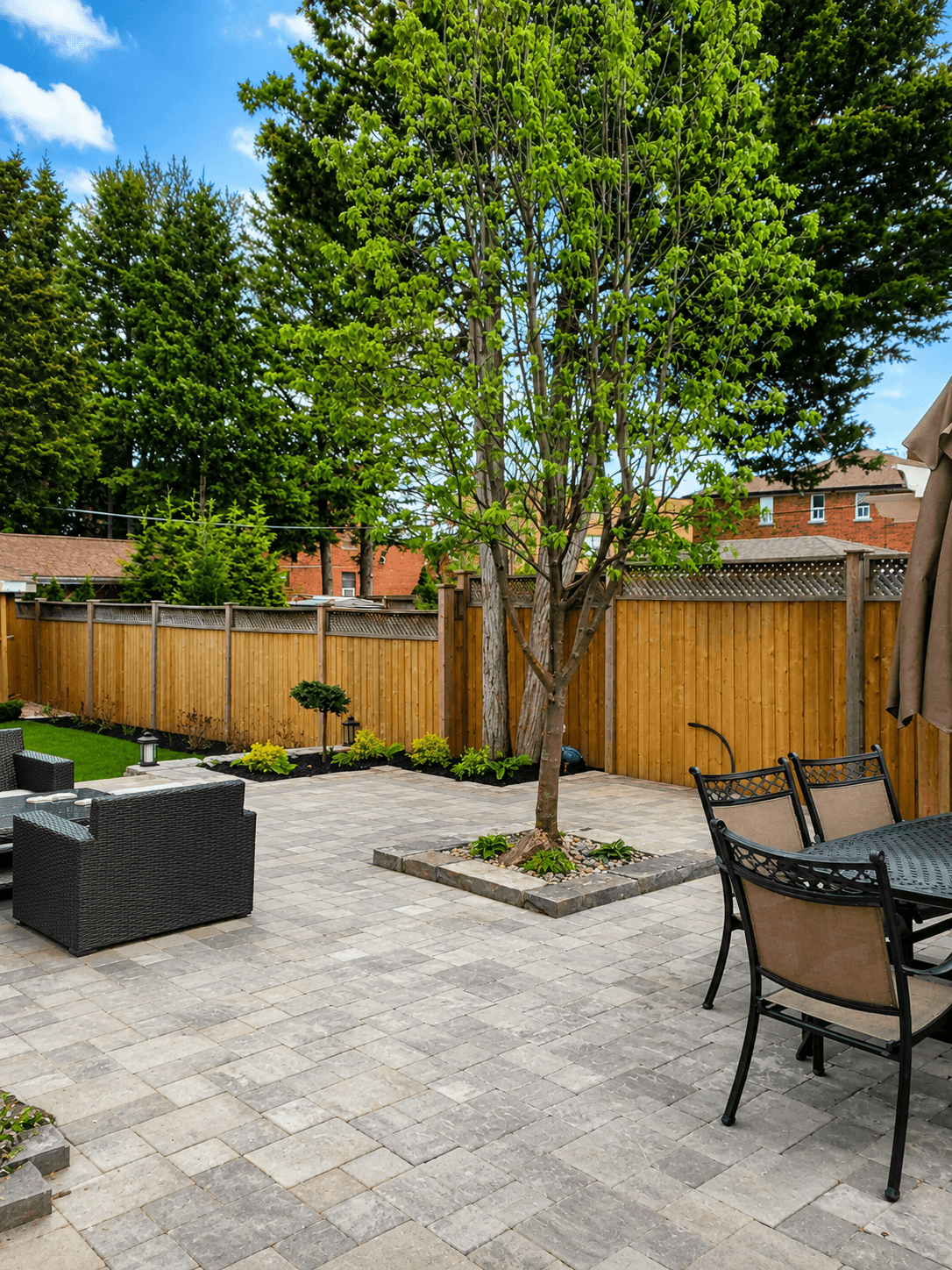
Landscape · spring-fall
Interlock — install, removal & re-lay
Interlock fails when the base does. Most contractors skimp on the granular — we don't. Pavers also need re-laying every 15–20 years; we do that too.
What we do differently
Built to last, not to ship.
The cheap version of this work isn't really cheap — it's deferred. Here's what we don't cut.
- 01
8-inch granular A base, compacted in 2-inch lifts
- 02
Bedding sand screeded flat, never thicker than 1 inch
- 03
Polymeric jointing sand on every install
- 04
Edge restraint on all sides
- 05
Re-lay service: lift, re-grade base, re-set existing stones
How a job runs
From first call to clean exit.
Every project follows the same arc. The detail changes, the discipline doesn't.
- 01
Excavate
8–12 inches depending on use.
- 02
Base
Granular A, compacted in lifts to 95% Proctor.
- 03
Bedding
Concrete sand screeded to 1 inch.
- 04
Lay
Stones laid to pattern, cut to fit.
- 05
Edge & joint
Edge restraint, polymeric sand, water-set.
FAQ
Common questions
Two reasons: regular sand was used instead of polymeric, or the polymeric has aged out (5–10 years). Solution: blow joints clean, re-poly, water in, done.
Base failure. Either it was undersized, or water got under it and froze. Re-lay = lift the stones, re-base properly, re-set. Most stones are reusable.
Interlock costs more upfront but lets you fix one stone if you stain it. Concrete is faster and cheaper but cracks travel. Both last decades installed correctly.
Interlock in your town
Every town within sixty kilometres, covered.
See interlock for your specific area — drive time, recent jobs, local notes.
- Interlock in Hagersville
- Interlock in Hamilton
- Interlock in Brantford
- Interlock in Caledonia
- Interlock in Cayuga
- Interlock in Dunnville
- Interlock in Simcoe
- Interlock in Jarvis
- Interlock in Port Dover
- Interlock in Ancaster
- Interlock in Stoney Creek
- Interlock in Waterford
- Interlock in Burford
- Interlock in Binbrook
- Interlock in Selkirk
- Interlock in Townsend
- Interlock in Tillsonburg
- Interlock in Paris
- Interlock in St. George
- Interlock in Mount Hope
- Interlock in Smithville
- Interlock in Grimsby
- Interlock in Beamsville
- Interlock in Dundas
- Interlock in Waterdown
- Interlock in Burlington
- Interlock in Oakville
- Interlock in Niagara-on-the-Lake
Free quotes
Ready for interlock?
Send us a couple lines about the project — square footage, photos, your address. We'll reply within a business day.

Dylan Ribeiro
Owner & lead · Hagersville, ON
Call the number and you get me, not a call centre.